Convulsed States: Earthquakes, Prophecy, and the Remaking of Early America by Jonathan Todd Hancock
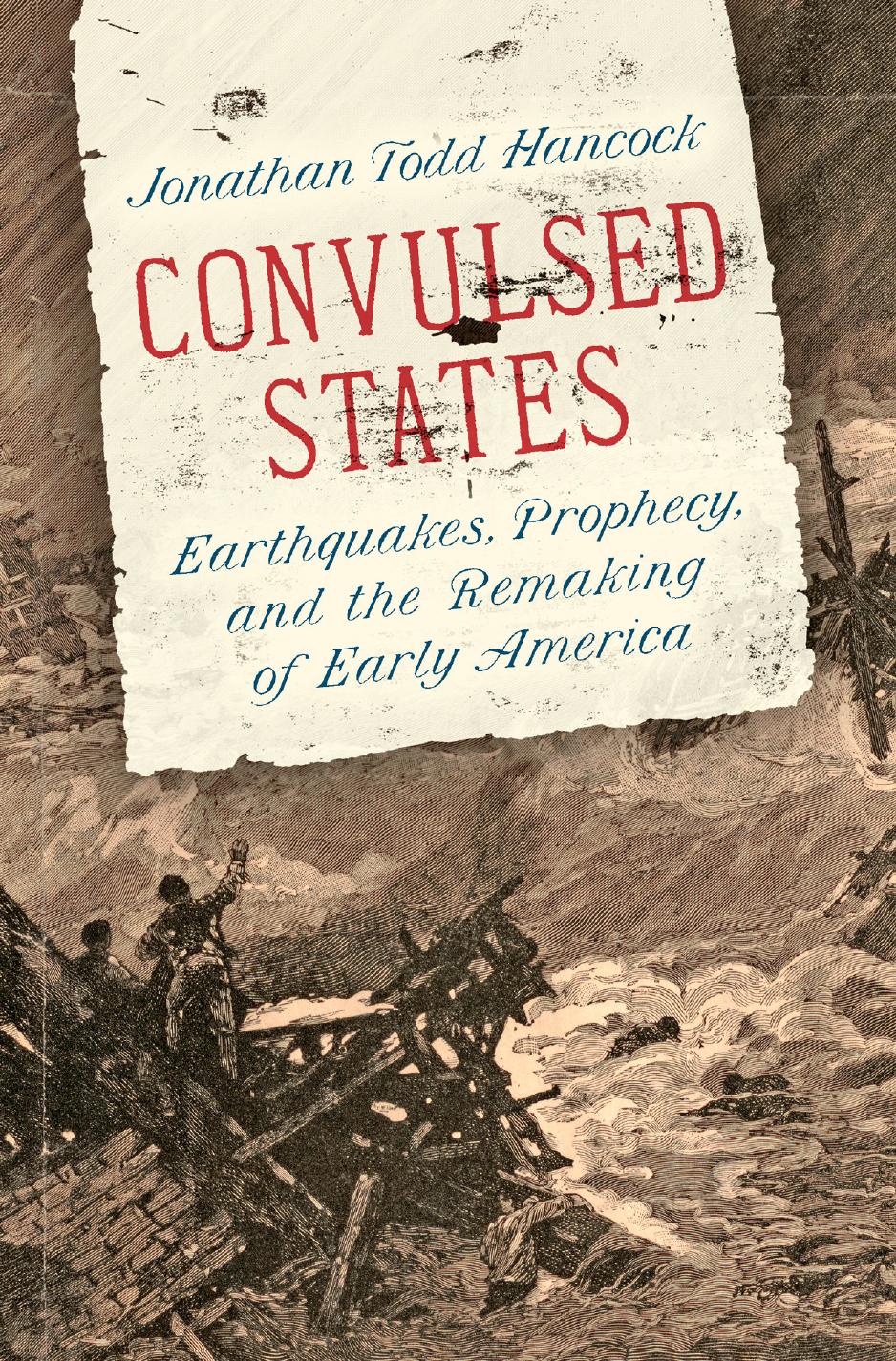
Author:Jonathan Todd Hancock [Hancock, Jonathan Todd]
Language: eng
Format: epub, pdf
ISBN: 9781469662183
Google: RY_XzQEACAAJ
Amazon: B08HGVN2ZL
Barnesnoble: B08HGVN2ZL
Goodreads: 55420026
Published: 2021-01-19T11:20:06+00:00
hensible to all of humanity, much less Hughesâ individual revelations. In the days after June 4, Wilmer sent his address to President Madison.20
Coupled with Adamsâs and Jeffersonâs private concerns about prophets
and âpolitical safety,â these denunciations showed that established political and religious authorities took Hughes and prophets like him seriously. In
the absence of a state church, Americans were free to associate with a range of religious denominations. Allegiance to those denominations was an especially meaningful collective enterprise, particularly west of the Appalachians, where political institutions in newer states and territories were even less established. These voluntary religious associations could anchor or threaten this composite system of U.S. governance. While Baptist and Methodist denominations grew in a mutually beneficial way with the territorial expansion of the nation- stateâat least until the issue of slavery split them along sec-tional linesâprophetic movements threatened the construction and main-
tenance of boundaries of religious and political authority in the early United States. Hughes did not wade into specific national political matters like his prophetic counterparts in Indian country, but he joined them in seeking to incorporate special spiritual insights into national politics. While his efforts drew strong rebukes, the broader political debate about the earthquakesâ
spiritual significance for the United States proved inescapable.
That debate emerged on the floor of Congress. Virginia representative
John Randolph pointed to the intertwined nature of environmental and geo-
political instability, not only in the United States but across the hemisphere.
In Caracas, Venezuela, an earthquake had killed between 15,000 and 20,000
Politics
101
people during the Catholic Holy Week of March 1812. Naturalists supposed a link between the seismic activity in the Mississippi River valley and Latin America, and in the first instance of U.S. foreign aid ever granted, Congress allocated $50,000 in aid for provisions to send to republican rebels in their fight for independence against loyalists of the Spanish Empire. Randolph
invoked the destruction in Caracas as well as other âsigns of the timesâ to wonder whether some worse fate awaited the United States: âI know that we
are on the brink of some dreadful scourgeâsome great desolationâsome
awful visitation from that Power, whom, I am afraid, we have as yet, in our national capacity, taken no means to conciliate. If other civilized people, if the other nations of Christendom have not escaped, what reason have we to
suppose that we shall be preserved from the calamities which Providence has thought fit to inflict on those nations which have ventured to intermingle in the conflicts now going on in Europe?â Randolph was an outspoken critic
of the ensuing war with Great Britain. By suggesting that the United States take âmeans to conciliateâ the prospect of divine judgment âin [its] national capacity,â he echoed Cherokee and Delaware leaders who argued that their
nations should look inward to address cosmological disruptions, rather than blaming foreign enemies for their problems.21
John C. Calhoun rose to counter Randolphâs warning. âI did hope, that
the age of superstition was past, and that no attempt would be made to in-
fluence the measures of government, which ought to be founded in wisdom
and
Download
Convulsed States: Earthquakes, Prophecy, and the Remaking of Early America by Jonathan Todd Hancock.pdf
This site does not store any files on its server. We only index and link to content provided by other sites. Please contact the content providers to delete copyright contents if any and email us, we'll remove relevant links or contents immediately.
| Anthropology | Archaeology |
| Philosophy | Politics & Government |
| Social Sciences | Sociology |
| Women's Studies |
Cecilia; Or, Memoirs of an Heiress — Volume 1 by Fanny Burney(32561)
The Great Music City by Andrea Baker(32021)
Cecilia; Or, Memoirs of an Heiress — Volume 2 by Fanny Burney(31958)
Cecilia; Or, Memoirs of an Heiress — Volume 3 by Fanny Burney(31944)
We're Going to Need More Wine by Gabrielle Union(19051)
All the Missing Girls by Megan Miranda(16043)
Pimp by Iceberg Slim(14517)
For the Love of Europe by Rick Steves(14155)
Bombshells: Glamour Girls of a Lifetime by Sullivan Steve(14079)
Talking to Strangers by Malcolm Gladwell(13375)
Norse Mythology by Gaiman Neil(13372)
Fifty Shades Freed by E L James(13245)
Mindhunter: Inside the FBI's Elite Serial Crime Unit by John E. Douglas & Mark Olshaker(9346)
Crazy Rich Asians by Kevin Kwan(9295)
The Lost Art of Listening by Michael P. Nichols(7507)
Enlightenment Now: The Case for Reason, Science, Humanism, and Progress by Steven Pinker(7315)
The Four Agreements by Don Miguel Ruiz(6767)
Bad Blood by John Carreyrou(6625)
Weapons of Math Destruction by Cathy O'Neil(6283)
